Tychonides
Finishing what Tycho Brahe started.
Reopen the observations that transformed astronomy.
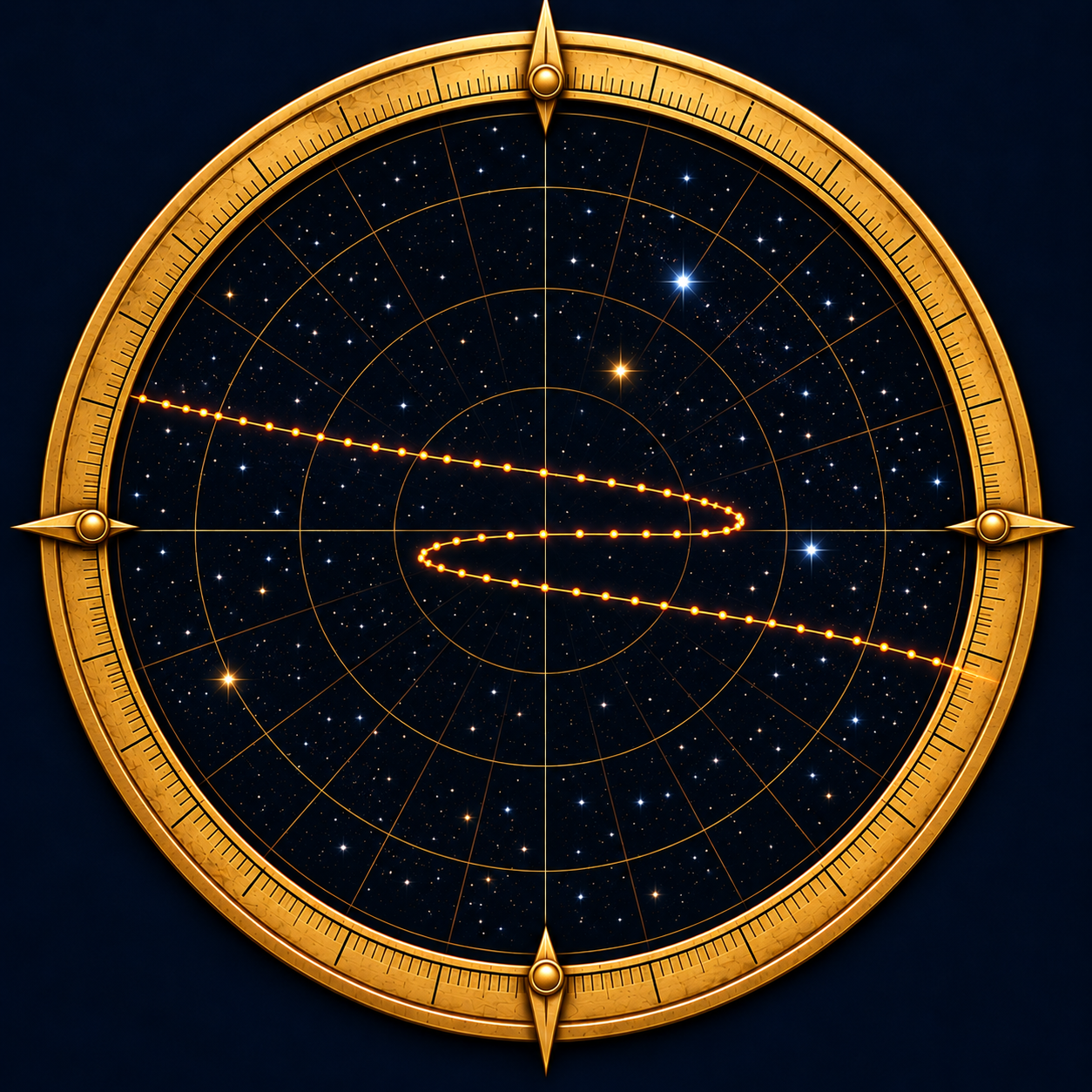
Against the background stars, Mars slows, reverses direction, and resumes its course. An astronomical model must explain that whole path and its timing. Tycho Brahe’s measurements made the problem precise; Kepler used them to develop his account of planetary motion.
Tychonides returns to the recorded evidence, bringing historical angles, clock readings, observing notes and calculations together with modern optical observations in one source-linked catalog. Tycho Brahe’s observations anchor a growing collection spanning many authors, works and observing programs, with planets, the Sun and Moon, comets and stars all contributing to the investigation.
The program connects data acquisition to historical model reconstruction, comparisons of contemporary and modern corrections, distance investigations and an interactive sky-and-orbit explorer. Further works and datasets will extend the same common catalog. See the research plan.
Available now
The downloadable catalog provides original numerical expressions, exact conversions, contextual relationships, source citations and verification tools in a single database and CSV export. Use it to inspect the evidence, compare source accounts and develop analyses. The source directory lists the historical and modern collections already available, with coverage and interpretation limits.
The 1595 Mars comparison follows a retrograde passage through four models. The opposition study sets Tycho’s Mars longitudes and the tables of his day against a modern ephemeris. The printed predictions study does the same for every planet the logs compare with a table. The refraction study sets the printed tables of Tycho and Riccioli beside modern refraction. The planetary correction comparisons show how historical and modern distance and refraction assumptions change the results. The studies page lists each finished analysis with its inputs and how to rerun it. The status page shows what is done and what comes next, and the research milestones cover predictive tests, parallax feasibility, and the interactive explorer.
Historical readings come from the published editions. Their numerical accuracy has no corpus-wide estimate. The Tycho subset has no accepted absolute observing timestamps. You can verify the released files, check individual readings against their citations, and run the public worked example. Rebuilding the historical catalog requires unpublished extraction and review inputs.
One sky, several models
The same observations can be approached through several astronomical systems:
| Model | Geometry to investigate |
|---|---|
| Ptolemaic | Earth-centered deferents and epicycles, with their documented parameters. |
| Copernican | Earth and the planets moving around the Sun, using the historical constructions. |
| Tychonic | The Sun moving around Earth, with the planets moving around the Sun. |
| Modern heliocentric | Elliptical orbits and numerical planetary ephemerides. |
The comparison concerns the directions each specified model predicts at the times of the observations. Some different descriptions produce the same relative motion and therefore the same directions. A change of viewing frame must be distinguished from a change in the model’s predictions.
What can the observations tell us?
- Motion: the shape and timing of retrograde loops, oppositions and changes in apparent celestial positions.
- Distance: constraints from orbital geometry and the much smaller shift in direction caused by a change of observing position, called parallax.
- Measurement: the effects of instruments, clock conventions and atmospheric refraction on the recorded angles.
- Theory: how an instrument reading became a corrected coordinate, an adopted position or a value in a planetary table.
A raw reading and a calculated position answer different questions. Tychonides preserves that distinction, along with repeated readings, printed corrections and uncertain interpretations. Diurnal parallax and orbital triangulation likewise remain separate approaches to distance.
The recorded observations remain the common evidence when corrections change. Analyses compare contemporary tables, beginning with Tycho’s refraction values, with modern calculations, making the effect of each correction choice visible. The correction comparison design describes these alternatives and their assumptions.
Read the sources
The source guide links public Ars Astronomica editions and PDFs, original printed witnesses and modern source collections. Catalog citations identify the publication and its page or native record location, so a numerical result can be followed back to its source. The source directory explains each collection’s contribution and the evidence needed to use it in an analysis.
A second transcription: Pafko’s Mars workbook
For his visualization project, Wayne Pafko manually entered records from Tycho’s printed observation logs into an Excel workbook. It contains source quotations, sexagesimal components and decimal-degree conversions. It was created separately from the Ars Astronomica editions and the Tychonides extraction, so it is an independent transcription of the same pages.
The original reconciliation linked all 923 workbook rows to source entries. Pafko’s quotations and the edition agree in unsigned magnitude for 906 rows, including 125 that also agree in hemisphere. Sixteen differed and one source value was incomplete. 685 rows received no source check, and source checks include structural review as well as reading checks. The workbook also informed parser development, so the agreement checks the readings and is not an independent test of the method. See the validation results and limits.
Quick start
From a source checkout, with Python 3.11+, Bash, curl, jq, gzip and SQLite:
python -m pip install .
./scripts/download-catalog downloads
sqlite3 downloads/tychonides.sqlite "SELECT subject, quantity, count(*) AS quantities FROM catalogue GROUP BY subject, quantity ORDER BY quantities DESC LIMIT 10;"
For download-only use and units, see the catalog guide. The download command retrieves the version pinned by this checkout, verifies it and produces the ready-to-query database. Large data files are versioned GitHub Release assets; cloning the repository alone does not download them.
Start here
| Your goal | Reading route |
|---|---|
| See what is done and what is next | Status → studies |
| Understand the project | Research program → sources and coverage |
| Use the data | Catalog guide → worked values → source uses |
| Verify or contribute | Workflow → ingestion strategy → public worked example → tests |
The documentation index guides readers through source coverage, research, processing and technical references. See also the observing policy.
Tychonides means “son of Tycho.” At Stjerneborg, Tycho placed a successor alongside astronomy’s great figures: after Copernicus and himself came Tychonides, whose verse addresses him as father and asks to carry on his work. An astronomer yet to make his mark already had a place among the greats. See Tycho’s account in Epistolarum Astronomicarum Libri (pp.279–280).
Accounts differ on whether the figure represented his young son or a hoped-for future heir (Ann Blair, Dreyer). The wider invitation is clear: in the Mechanica (p.144), Tycho encourages future practitioners to adapt and improve his work.
Tychonides takes up that invitation: bring the observations back into calculation, and turn unresolved questions into new discoveries.
Code: AGPL-3.0-or-later · Data: CC0-1.0, with source terms preserved.
tychonides.com · an Ars Astronomica project.