Historical refraction tables against modern refraction
Tycho corrected his altitudes with printed refraction tables: one for the Sun and one for the fixed stars. Riccioli later printed tables for the Sun, the Moon, and the stars in three seasons. This study sets each table entry beside a modern refraction formula at the same altitude. Progymnasmata, pp. 79 and 280 · Astronomia Reformata, p. 47
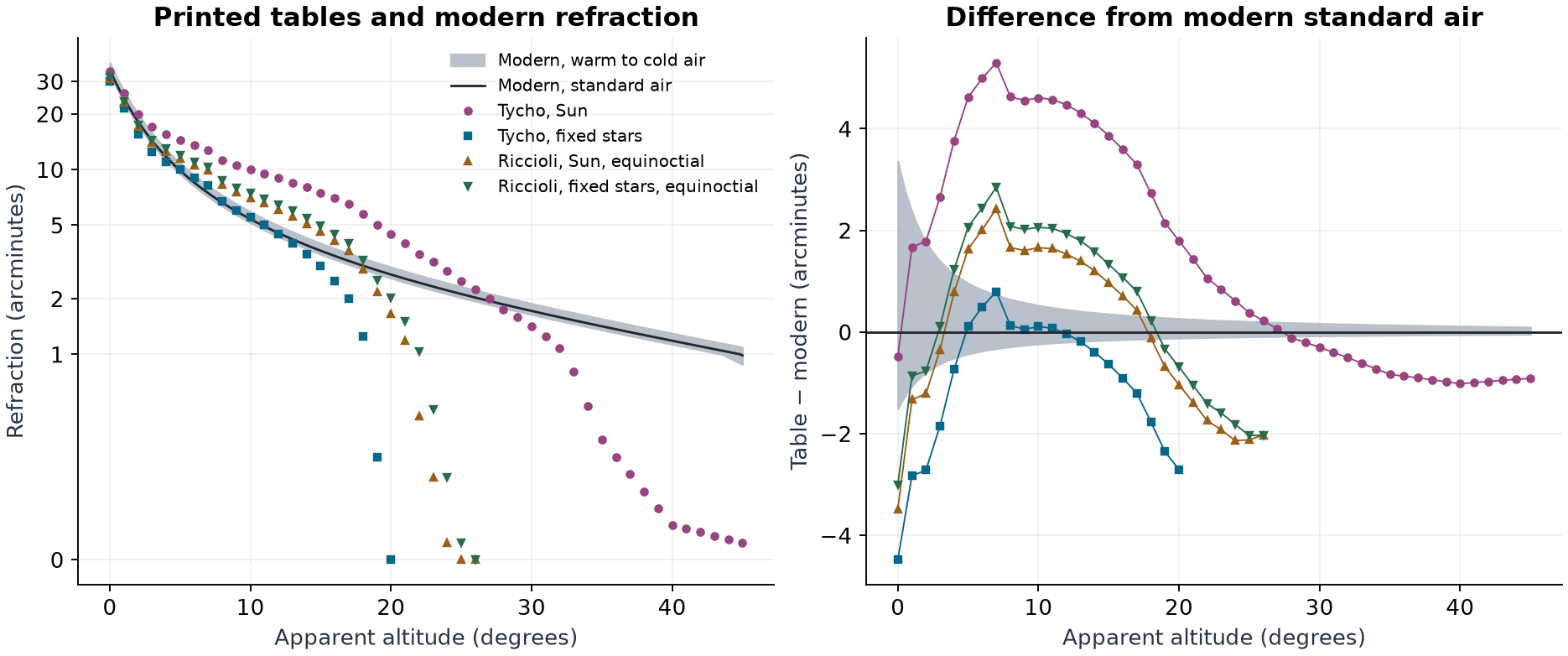
The gray band spans modern refraction from warm air (20 °C, 1000 hPa) to cold air (−10 °C, 1030 hPa). The black line is standard air (10 °C, 1010 hPa).
| Altitude | Modern, standard air | Tycho, Sun | Tycho, fixed stars | Riccioli, Sun, equinoctial | Riccioli, fixed stars, equinoctial |
|---|---|---|---|---|---|
| 0° | 34′29″ | 34′00″ | 30′00″ | 31′00″ | 31′28″ |
| 5° | 9′53″ | 14′30″ | 10′00″ | 11′31″ | 11′57″ |
| 10° | 5′23″ | 10′00″ | 5′30″ | 7′03″ | 7′27″ |
| 15° | 3′38″ | 7′30″ | 3′00″ | 4′36″ | 4′58″ |
| 20° | 2′42″ | 4′30″ | 0′00″ | 1′40″ | 2′01″ |
| 30° | 1′43″ | 1′25″ | |||
| 45° | 1′00″ | 0′05″ |
What the comparison shows
- Tycho’s fixed-star table is close to modern refraction from 4° to 16°. It stays within 1′ of standard air there, and within 7″ at 5° and 10°. It is 4½′ low at the horizon. It then falls to zero at 20°, where modern refraction is 2′42″.
- Tycho’s solar table is 4½′ larger than his stellar table. The two differ by exactly 4′30″ at 5°, 10°, 15°, and 20°. The catalog’s record of Riccioli’s reprint notes his statement that Tycho obtained the stellar values by subtracting 4½′ from the solar ones. The solar table therefore sits 4.5′ to 5.3′ above modern refraction from 5° to 12°, crosses it between 27° and 28°, and ends at 5″ at 45°, where modern refraction is 1′00″.
- The solar excess does not cancel his solar parallax. Tycho took the Sun’s horizontal parallax as 3′, about twenty times the modern value. His refraction minus his parallax differs from the modern pair by +1.8′ at 5° and 10°, −0.9′ at 20°, −2.8′ at 30°, and −2.9′ at 45°.
- Above 20° his star altitudes carry no refraction correction. The omitted amount falls from 2′42″ at 20° to 1′00″ at 45°.
Riccioli’s tables follow Tycho’s
Riccioli’s equinoctial solar table equals Tycho’s solar table less Tycho’s own solar parallax in altitude. From 0° to 24° the two agree within 1.1″ at every degree except 7°, where they differ by 6.6″. At 25° and 26°, where that difference would be negative, Riccioli prints zero. The derivation check lists every altitude. The agreement suggests how the table was built. Riccioli’s text has not been read for this study, so the derivation is an inference from the numbers.
For the Sun, his winter values exceed his summer values by 7% at the horizon, 19% at 5°, and 41% at 15°. A 25 °C change in air temperature changes modern refraction by about 9% at every altitude. The seasonal spread in his tables therefore grows with altitude in a way temperature alone does not produce. The season file gives each pair.
One entry breaks its table’s sequence. The summer fixed-star value at 10° is 7′38″, above the 7′06″ at 9° and the 6′11″ at 11°. It is kept as the catalog gives it and listed for a check against the printed page.
Limits
- This compares printed tables, not observed refraction. It does not test the altitudes from which the tables were made.
- The modern values use Bennett’s formula for apparent altitude. The conditions at Uraniborg and Bologna on any night are unknown, and the band shows how much they matter. Each table’s argument is taken as apparent altitude.
- Several tables cannot be used yet. The catalog holds Tycho’s lunar table, Longomontanus’s three tables, and Riccioli’s reprint of Tycho’s tables, 277 entries in all, without the altitude that belongs to each entry. Two entries of Tycho’s solar table are in the same state. An altitude is never supplied from the order of the entries, so these are listed and left out.
Inputs and reproduction
The selection script reads Tychonides 1.3.1 and writes the table entries with their catalog identities. The analysis script writes the entry-by-entry comparison, the summary, the checks linked above, and the figure. It runs offline and needs NumPy for the tables and Matplotlib for the figure.
Modern refraction is R = 60 cot(h + 7.31/(h + 4.4)) arcseconds for apparent
altitude h in degrees, multiplied by (P/1010)(283/(273 + T)) for pressure
P in hectopascals and temperature T in degrees Celsius. Tycho’s solar
parallax in altitude is asin(1/1146) cos h, from his solar distance of 1,146
Earth radii. Bennett’s refraction formula
python examples/refraction_select.py downloads/tychonides.sqlite
python examples/refraction_tables.py --output docs/figures
Only the second command is needed to regenerate the tables and figure.