Printed predictions for the Moon and planets
Tycho’s logs print positions computed from the tables and ephemerides of his day beside his own observations. This study collects every such longitude and latitude of the Moon and the five planets, 485 in all from 1563 to 1600. Each is compared with the log’s own value for the same date and with the modern JPL DE441 ephemeris.
The Mars opposition study compared the predictions printed near nine oppositions of Mars. This study adds the other bodies and the rest of the logs.
Main results
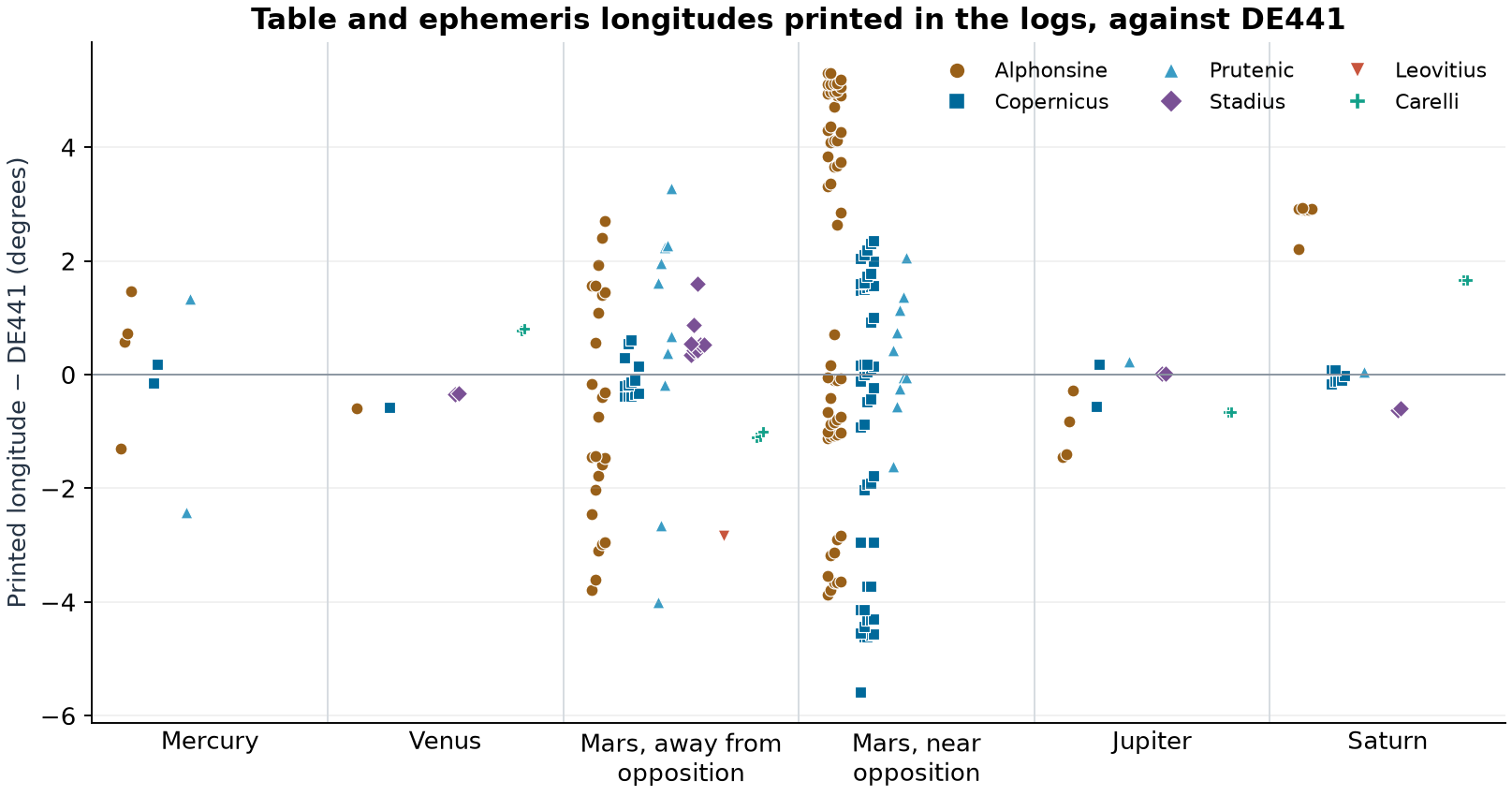
- Saturn separates the tables most clearly. Six Alphonsine longitudes of Saturn from 1590 and 1591 run 2.9° ahead of DE441, and one from 1595 runs 2.2° ahead. The seven Copernican longitudes of 1591 stay within 10′.
- The Copernican latitudes of Saturn are a degree off. The seven printed in 1591 lie 53′ to 61′ south of DE441. The eight Alphonsine latitudes stay within 7′.
- Jupiter follows the same pattern in longitude. Four Alphonsine longitudes fall 16′ to 87′ behind. The Copernican and Prutenic ones lie between 33′ behind and 14′ ahead.
- For Mars, the Copernican error depends on where Mars is. More than 60 days from an opposition, the 13 Copernican longitudes have a median difference of 20′ and none exceeds 37′. Near opposition the median is 1.9°. The Alphonsine medians are 1.6° and 3.6°.
- Mercury in February 1592. With the hours the log prints, the Copernican longitudes are 11′ ahead and 9′ behind. The Alphonsine ones are 35′ and 88′ ahead.
- Tycho’s own values agree with DE441 far better than any table. Where the log prints the hour, the median difference between his longitude and DE441 is 0.4′ to 4.8′ for Mars, 4′ for Mercury and Venus, and 0.1′ for Jupiter.
Longitudes
Each cell is the printed value minus DE441, in arcminutes.
| Body | Source | Predictions | Mean | Median size | Largest |
|---|---|---|---|---|---|
| Mercury | Alphonsine | 4 | +22 | 61 | 88 |
| Mercury | Copernicus | 2 | +1 | 10 | 11 |
| Mercury | Prutenic | 2 | −33 | 113 | 146 |
| Venus | Alphonsine | 1 | −35 | 35 | 35 |
| Venus | Copernicus | 1 | −35 | 35 | 35 |
| Venus | Stadius | 2 | −20 | 20 | 21 |
| Venus | Carelli | 2 | +48 | 48 | 48 |
| Mars, away from opposition | Alphonsine | 25 | −37 | 94 | 227 |
| Mars, away from opposition | Copernicus | 13 | −4 | 20 | 37 |
| Mars, away from opposition | Prutenic | 10 | +34 | 126 | 240 |
| Mars, away from opposition | Stadius | 8 | +40 | 32 | 96 |
| Mars, away from opposition | Leovitius | 1 | −170 | 170 | 170 |
| Mars, away from opposition | Carelli | 3 | −64 | 65 | 66 |
| Mars, near opposition | Alphonsine | 57 | +88 | 219 | 318 |
| Mars, near opposition | Copernicus | 50 | −58 | 111 | 335 |
| Mars, near opposition | Prutenic | 10 | +20 | 39 | 124 |
| Jupiter | Alphonsine | 4 | −59 | 66 | 87 |
| Jupiter | Copernicus | 2 | −11 | 22 | 33 |
| Jupiter | Prutenic | 1 | +14 | 14 | 14 |
| Jupiter | Stadius | 2 | +1 | 1 | 1 |
| Jupiter | Carelli | 2 | −39 | 39 | 39 |
| Saturn | Alphonsine | 7 | +169 | 174 | 176 |
| Saturn | Copernicus | 7 | −3 | 6 | 9 |
| Saturn | Prutenic | 1 | +3 | 3 | 3 |
| Saturn | Stadius | 2 | −37 | 37 | 37 |
| Saturn | Carelli | 2 | +100 | 100 | 100 |
“Near opposition” means within 60 days of an opposition in Longomontanus’s table, the window of the opposition study. The sources are named as the log names them. Stadius, Leovitius, and Carelli published ephemerides. The others are tables. The log keeps “Copernicus” and “Prutenic” apart, and so does this page, although the Prutenic Tables rest on Copernicus’s models.
The samples cover different years, so two rows are not a like-for-like test of two sources. The Copernican and Prutenic rows for Mars away from opposition, for example, share one date.
Latitudes
| Body | Source | Predictions | Mean | Median size | Largest |
|---|---|---|---|---|---|
| Mercury | Alphonsine | 4 | −18 | 22 | 32 |
| Mercury | Copernicus | 2 | +3 | 7 | 10 |
| Mercury | Prutenic | 2 | −78 | 78 | 87 |
| Venus | Alphonsine | 1 | +74 | 74 | 74 |
| Venus | Copernicus | 1 | +168 | 168 | 168 |
| Mars, away from opposition | Alphonsine | 15 | −5 | 17 | 60 |
| Mars, away from opposition | Copernicus | 10 | −15 | 14 | 42 |
| Mars, away from opposition | Prutenic | 3 | −33 | 43 | 59 |
| Mars, away from opposition | Stadius | 1 | −19 | 19 | 19 |
| Mars, away from opposition | Leovitius | 1 | −13 | 13 | 13 |
| Mars, near opposition | Alphonsine | 45 | −9 | 12 | 54 |
| Mars, near opposition | Copernicus | 46 | +20 | 35 | 73 |
| Mars, near opposition | Prutenic | 5 | −5 | 40 | 54 |
| Jupiter | Alphonsine | 5 | +12 | 14 | 32 |
| Jupiter | Copernicus | 2 | +3 | 37 | 40 |
| Jupiter | Prutenic | 2 | −1 | 2 | 3 |
| Saturn | Alphonsine | 8 | −4 | 5 | 7 |
| Saturn | Copernicus | 7 | −59 | 60 | 61 |
| Saturn | Prutenic | 1 | −50 | 50 | 50 |
A positive difference is north of DE441. In September 1591 the printed latitudes of Venus are −2° 17′ (Alphonsine) and −0° 43′ (Copernicus), where DE441 gives −3° 31′ and the log −3° 22′.
The summary also gives every difference from the log, and the medians for the rows with printed hours. The results list each prediction.
May 1564
The earliest entries compare the ephemerides of Stadius and Carelli on May 1 and 2, 1564, when Tycho was seventeen. Stadius’s Jupiter is 1′ from DE441 on both days. Carelli’s Saturn is 100′ ahead.
On May 1 the log’s own longitudes for Venus, Mars, Jupiter, and Saturn are whole degrees, and all four lie 91′ to 107′ east of DE441. This study does not explain that shared offset. It is recorded as a question for the reading of that page.
The Moon is listed and not compared
The logs print 59 predictions of the Moon on 12 dates. The log has values of its own on some of those dates, but none carries a usable printed hour. The Moon moves 6° to 7° in longitude in twelve hours, and an observed place of the Moon can include up to a degree of parallax. Without the hour the comparison has no meaning, so the differences are left blank. Several dates carry two or three values from one table that differ by up to 1.75°, which suggests calculations for different hours.
Rows flagged or set aside
- Venus, July 15, 1590. The longitudes printed on Opera Omnia XII p. 71 are 127° 50′ and 127° 00′. DE441 puts Venus at 76° on that date. No table of the period errs by 51°, so the date or the body of this entry is in question. Its four predictions are flagged, kept in the results, and left out of the tables above. The rule flags any longitude more than 10° from DE441, together with the other predictions of that body in the same printed entry.
- Mars, 1599 and 1600. The catalog records no calendar for 40 predictions from these years. Read as Julian, the log’s own longitudes of October 1599 lie 4.3° to 4.7° from DE441, the pattern of a ten-day calendar shift. These predictions are reported as a separate set in the summary file.
- One Copernican entry for Mars in 1591 is printed as 4 sexagenae 7° 42′ with no zodiac sign. It is not a place within a sign and is left out.
| Left out | Count | Reason |
|---|---|---|
| Predictions without a printed latitude direction | 36 | A direction is never supplied from neighboring entries. |
| Predictions without one complete date | 11 | The date claim is missing, partial, or multiple. |
| Predictions without a model name | 9 | The table cannot be identified. |
| Prediction of 30° or more without a zodiac sign | 1 | It cannot be a place within a sign. |
| Log values superseded on their date | 55 | The log prints an adopted value for the same date. |
| Log values without a printed zodiac sign | 38 | A sign is never supplied from neighboring entries. |
| Log values without a printed latitude direction | 37 | As above. |
The excluded candidates are listed one by one. Forty-five predicted longitudes have no printed zodiac sign and are compared within the sign.
Limits
- The hour of a prediction is not stated. DE441 is taken at the hours of the log’s own values for that date where the log prints them, which covers 169 predictions. The other 257 compared predictions use local noon. In twelve hours DE441 moves by up to 36′ in longitude for Mercury and Venus, 22′ for Mars, 4′ for Jupiter, and 3′ for Saturn. The noon-based differences carry that much uncertainty. The Jupiter and Saturn results hardly depend on it.
- Small samples. Mercury appears on 3 dates, Venus on 3 after the flagged entry, Jupiter on 7, and Saturn on 11. Mars appears on 98.
- Repeated entries count each time. A later summary page can repeat a prediction from an earlier page. In 1593, Opera Omnia XII p. 291 prints the values of pp. 284 to 286 with dates one day earlier, so a date can itself be uncertain by a day.
- These are the values as printed. A slip in the arithmetic of a printed calculation counts here as an error of its table.
- One observing site is assumed. Local time is converted with the longitude of Uraniborg for every year. Tycho worked elsewhere before 1576 and after 1597. The difference is at most about ten minutes of time, under 1′ for every planet.
- Nothing is fitted. Under the project’s model-comparison protocol this compares printed predictions with published values. It is not a predictive test of any model.
Inputs and reproduction
The selection script states its rules and reads the released catalog. It writes the predictions, the log values on the same dates, and the excluded candidates. No ephemeris is consulted in the selection.
The ephemeris script caches the JPL Horizons positions: apparent geocentric ecliptic longitude and latitude of date. The analysis script then runs offline:
python examples/predictions_select.py downloads/tychonides.sqlite
python examples/predictions_ephemeris.py
python examples/printed_predictions.py --output docs/figures
A test regenerates the tables from the committed inputs, and a second test checks the input files against the catalog.