Mars at the oppositions of 1580 to 1600
Longomontanus tabulates fourteen oppositions of Mars from 1580 to 1610. Tycho’s logs cover the first ten. This study repeats the 1595 comparison at each of them, with one set of rules, and asks three questions:
- How close are Tycho’s reduced longitudes to a modern ephemeris?
- How do Ptolemaic, Copernican, and Tychonic constructions follow each passage?
- How close were the table predictions Tycho printed beside his reductions?
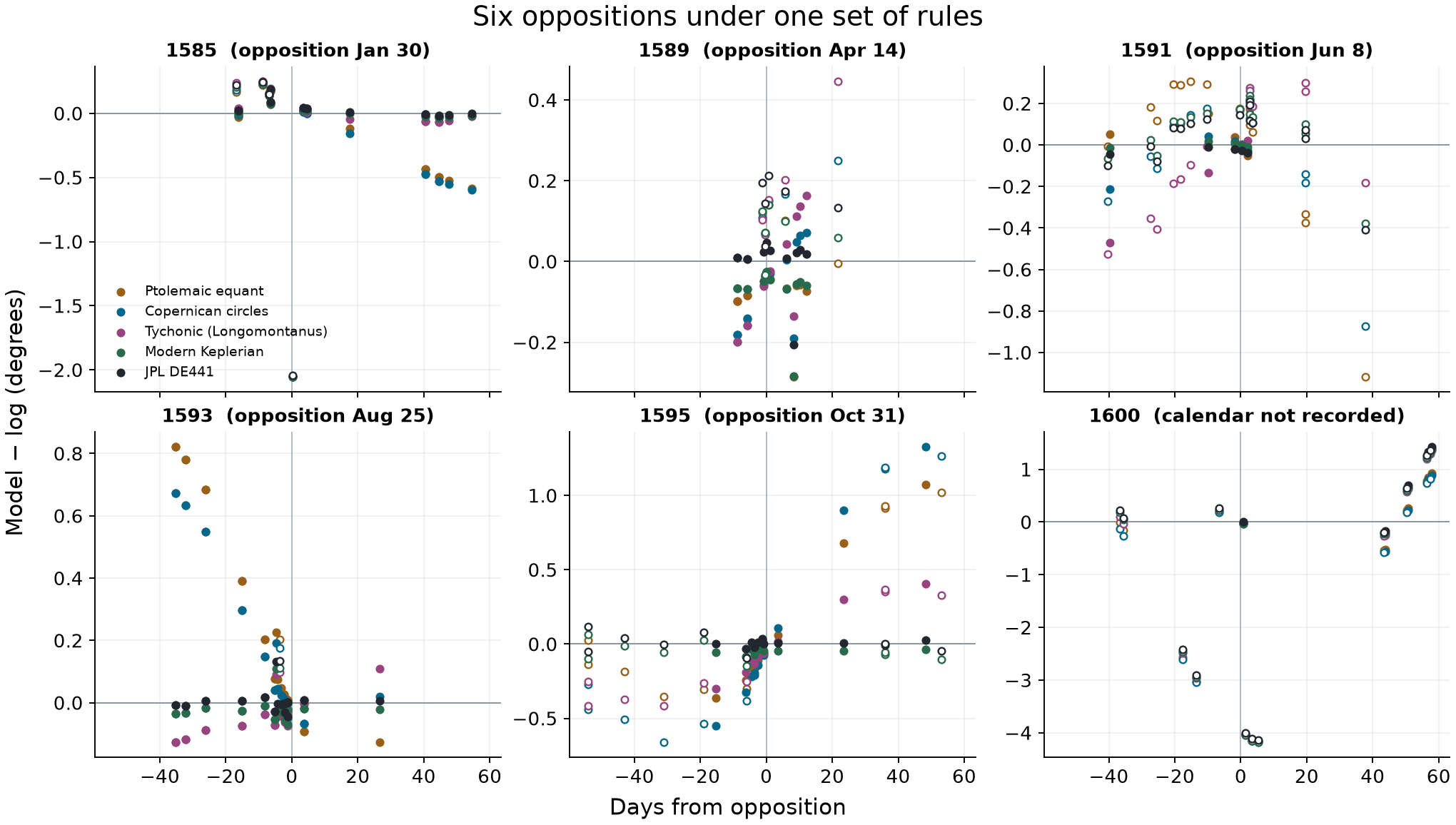
Filled points have a printed hour the study can use. Open points are evaluated at local noon. The vertical scale differs between panels.
Tycho’s longitudes against a modern ephemeris
At nine oppositions, where the log prints a usable hour, Tycho’s reduced longitudes differ from the JPL DE441 ephemeris by 0.5′ to 4.6′ RMS. The mean difference stays within 1.7′ at every one of them.
| Opposition | Dates | Rows | Rows with a usable hour | DE441 − log, RMS on those rows | Mean | DE441 − log, RMS on all rows |
|---|---|---|---|---|---|---|
| 1580 Nov 18 | 4 | 7 | 2 | 2.5′ | −0.1′ | 83′ |
| 1582 Dec 28 | 5 | 8 | 6 | 1.7′ | +1.5′ | 4.3′ |
| 1585 Jan 30 | 11 | 21 | 15 | 2.6′ | +1.1′ | 37′ |
| 1587 Mar 6 | 5 | 5 | 4 | 1.6′ | +1.5′ | 2.5′ |
| 1589 Apr 14 | 11 | 18 | 12 | 4.6′ | −0.6′ | 6.5′ |
| 1591 Jun 8 | 14 | 20 | 5 | 1.8′ | −1.7′ | 8.3′ |
| 1593 Aug 25 | 17 | 26 | 25 | 1.4′ | +0.1′ | 2.0′ |
| 1595 Oct 31 | 16 | 21 | 12 | 1.0′ | +0.5′ | 2.4′ |
| 1597 Dec 13 | 4 | 6 | 3 | 0.5′ | +0.1′ | 5.3′ |
The last column includes rows evaluated at local noon, where Mars can move several arcminutes between noon and the unrecorded hour. It also includes two rows that lie more than half a degree from the ephemeris: one on December 24, 1580 (Opera Omnia X, p. 88) and one on January 31, 1585 (X, p. 390). They account for the 83′ and 37′. Both stay in the selection, because the rule does not consult an ephemeris, and both are listed for a check against the printed page.
Historical constructions
Each historical curve passes through Longomontanus’s observed opposition longitude at his printed time and uses the apsidal direction implied by his row. The table gives the RMS difference from the log on rows with a usable hour, for the five oppositions with at least eleven dated nights.
| Opposition | Ptolemaic equant | Copernican circles | Tychonic, Longomontanus | Modern Keplerian elements | JPL DE441 |
|---|---|---|---|---|---|
| 1585 Jan 30 | 0.36° | 0.38° | 0.06° | 0.04° | 0.04° |
| 1589 Apr 14 | 0.12° | 0.11° | 0.14° | 0.12° | 0.08° |
| 1591 Jun 8 | 0.07° | 0.08° | 0.19° | 0.01° | 0.03° |
| 1593 Aug 25 | 0.49° | 0.39° | 0.08° | 0.03° | 0.02° |
| 1595 Oct 31 | 0.44° | 0.57° | 0.21° | 0.05° | 0.02° |
The four oppositions with fewer dated nights are reported separately. Their rows sit close to opposition, where every anchored curve agrees.
| Opposition | Ptolemaic equant | Copernican circles | Tychonic, Longomontanus | Modern Keplerian elements | JPL DE441 |
|---|---|---|---|---|---|
| 1580 Nov 18 | 0.14° | 0.19° | 0.09° | 0.05° | 0.04° |
| 1582 Dec 28 | 0.21° | 0.38° | 0.19° | 0.02° | 0.03° |
| 1587 Mar 6 | 0.08° | 0.06° | 0.04° | 0.06° | 0.03° |
| 1597 Dec 13 | 0.07° | 0.10° | 0.05° | 0.02° | 0.01° |
What these tables support, and what they do not:
- They do not rank the world systems. Longomontanus derived the Tychonic parameters from these same oppositions, so its curve is fitted to this data and the other two are not.
- The numbers move with a shared assumption. Shifting the apsidal line by 10° or 20° changes the 1593 values to between 0.36° and 0.84° (Ptolemaic), 0.26° and 0.73° (Copernican), and 0.11° and 0.32° (Tychonic), over all rows. The sensitivity file gives every opposition.
- Coverage differs. In 1589 the dated nights run from 9 days before opposition to 22 days after, where anchored curves have little room to separate. In 1591 only five rows have a usable hour.
- The retrograde arcs do differ by construction. They are smallest near Mars’s perihelion in 1593 and largest in 1585.
| Opposition | Ptolemaic | Copernican | Tychonic | Modern Keplerian |
|---|---|---|---|---|
| 1585 Jan 30 | 19.8° | 19.8° | 19.6° | 19.5° |
| 1589 Apr 14 | 17.3° | 16.7° | 16.5° | 17.3° |
| 1591 Jun 8 | 13.7° | 13.2° | 12.3° | 12.9° |
| 1593 Aug 25 | 11.5° | 11.2° | 10.3° | 10.6° |
| 1595 Oct 31 | 14.8° | 14.3° | 15.2° | 16.0° |
The predictions Tycho printed
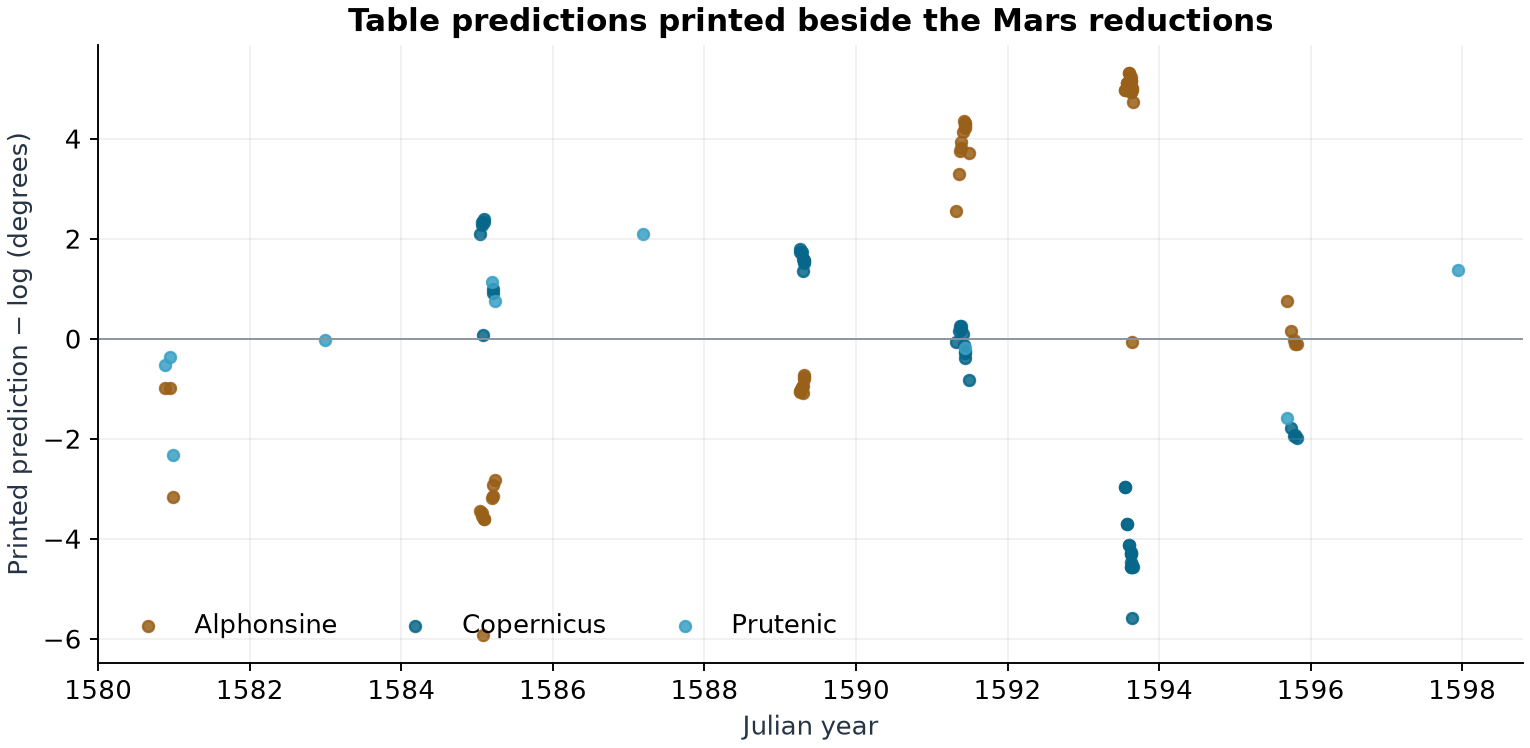
The logs print table predictions beside the reductions and name the table: Alphonsine, Copernicus, or Prutenic. Each is compared with the log’s reduction for the same date and with DE441 at that reduction’s time.
| Opposition | Alphonsine | Copernicus | Prutenic |
|---|---|---|---|
| 1580 Nov 18 | −42′ (3) | −4′ (3) | |
| 1582 Dec 28 | −3′ (1) | ||
| 1585 Jan 30 | −205′ (10) | +112′ (8) | +57′ (2) |
| 1587 Mar 6 | +124′ (1) | ||
| 1589 Apr 14 | −57′ (9) | +96′ (9) | |
| 1591 Jun 8 | +231′ (12) | −8′ (11) | −14′ (1) |
| 1593 Aug 25 | +284′ (16) | −253′ (16) | |
| 1595 Oct 31 | +8′ (5) | −115′ (4) | −97′ (1) |
| 1597 Dec 13 | +83′ (1) |
Each cell is the mean of prediction minus DE441, with the number of predictions in parentheses. The prediction summary also gives the differences from the log and the medians.
- Neither table is reliably closer. The Alphonsine predictions run 3.4° behind in 1585 and 4.7° ahead in 1593. The Copernican ones run 1.9° ahead in 1585 and 4.2° behind in 1593. In 1595 the Alphonsine values happen to fall within 10′ on four of five dates.
- The errors belong to the tables. Measured from the log or from DE441, the means agree within 3′ at the oppositions that have no flagged row.
- These errors are far larger than those of the anchored curves. A printed prediction carries its table’s epoch and mean-motion errors. An anchored curve removes them.
Limits: the log does not state the hour of a prediction. Predictions printed without a zodiac sign are compared within the sign. Four predictions in 1591 have no reduction on their date and are not compared. One Copernican entry in 1591 is printed as 4 sexagenae 7° 42′, or 247° 42′, with no zodiac sign. It is not a place within a sign, so it is left out. An earlier version of this page compared it within the sign, 11° from the log, which put the Copernican mean for 1591 at +48′.
The opposition table against DE441
Each row of Longomontanus’s table gives the instant at which Mars stood opposite the Sun and the longitude of Mars at that instant. Both can be recomputed from DE441: the instant at which the apparent longitude of Mars is 180° from that of the Sun, and the longitude of Mars then.
| Opposition | Table minus DE441 longitude | DE441 opposition after the tabulated instant | Sun implied by the row minus DE441 |
|---|---|---|---|
| 1580 Nov 18 | −1.8′ | −0.84 h | −3.9′ |
| 1582 Dec 28 | −0.9′ | +1.12 h | +1.9′ |
| 1585 Jan 30 | +0.3′ | +1.14 h | +3.2′ |
| 1587 Mar 6 | −1.7′ | +3.24 h | +6.4′ |
| 1589 Apr 14 | −2.0′ | +2.53 h | +4.1′ |
| 1591 Jun 8 | +1.2′ | −0.45 h | +0.1′ |
| 1593 Aug 25 | −3.1′ | −2.38 h | −8.9′ |
| 1595 Oct 31 | −3.9′ | −1.06 h | −6.6′ |
| 1597 Dec 13 | +0.7′ | −0.38 h | −0.3′ |
| 1600 Jan 18 | −0.2′ | +2.18 h | +5.4′ |
| 1602 Feb 20 | −0.5′ | +3.17 h | +7.4′ |
| 1604 Mar 28 | −0.6′ | +2.50 h | +5.5′ |
| 1608 Jul 24 | −1.7′ | −1.23 h | −4.7′ |
| 1610 Oct 8 | −1.0′ | −1.66 h | −5.2′ |
- The longitudes reproduce. All fourteen lie between 3.9′ behind and 1.2′ ahead of the DE441 longitude at opposition, and twelve lie within 2′. The mean difference is −1.1′.
- The instants differ by up to three hours, by season. The DE441 opposition falls 1.1 to 3.2 hours after the tabulated instant at the seven oppositions from late December to mid-April. It falls 0.4 to 2.4 hours before it at the seven from June to mid-December.
- The pattern is that of the solar theory. A row asserts that the Sun stood opposite its longitude at its instant. That implied Sun runs up to 7.4′ ahead of DE441 in February and March and up to 8.9′ behind in late August. It agrees within 0.3′ at the oppositions of June 1591 and December 1597. The eccentric solar circle of the Astronomia Danica, with eccentricity 1/28, has a largest equation of 2° 03′. The Earth’s orbit in 1600 gives 1° 56′. A solar equation too large by that 7′ accounts for the implied Sun within 2.7′ in every row.
The refraction study found Tycho’s corrections to a solar altitude 2.8′ to 2.9′ from the modern ones between 30° and 45°. At an equinox an altitude error of that size moves a longitude taken from the Sun’s declination by about 7′. The two results are consistent. This page does not test the link.
The tenth row is read with January, the month its own mean-longitude column requires, where the catalog gives June. It reproduces like the others. The last four rows postdate Tycho’s death in 1601 and reproduce equally well.
Limits: the tabulated hours are taken as mean time at Uraniborg, counted from noon. The equation of time, up to 16 minutes, is not applied. It can move an offset by 0.3 hours and the implied Sun by 0.7′. The script reads cached JPL Horizons positions of Mars and the Sun every six hours and writes the full comparison.
The 1600 opposition is set aside
By count, 1600 belongs with the main set: 17 rows on 13 dates. Read as catalogued, 11 of those rows lie more than half a degree from the ephemeris, by up to 4°. The pattern is that of a ten-day calendar shift. Tycho was then in Bohemia, where the Gregorian calendar was in use. Reading every date as Gregorian lowers the RMS from 2.3° to 1.5° but does not remove it, which suggests that these pages mix the two calendars, as the 1591 pages do. The catalog records no calendar for these entries. The opposition is set aside until it does, and its rows remain in the output files.
What was fixed in advance and what changed
The selection, time, and anchor rules were written for 1595 before any other opposition was computed. The first run over all ten then exposed two defects in the rules, which were corrected, and prompted one addition. All three were made after seeing residuals, so they are listed here.
- Calendar labels. In 1591 the log prints calculations from Magini’s Padua observations with Gregorian dates, and the catalog labels them so. The rule had ignored the label. It now moves a date labeled Gregorian ten days earlier.
- The month of the 1600 opposition. The catalog gives June for the tenth row of Longomontanus’s table. The table’s own mean-longitude column places it in January, and the rule now tests every row against that column.
- Counts of distant rows. The summary gained a count of rows more than half a degree from DE441 and a median difference. No row is removed on that basis.
What was left out
| Left out | Count | Reason |
|---|---|---|
| Oppositions of 1602, 1604, 1608, and 1610 | 4 | Tycho’s logs end in 1601. No reduction falls in their windows. |
| The 1600 opposition | 1 | The calendar of its entries is not recorded. |
| Trial reductions | 38 | The log prints an adopted value for the same date. |
| Reductions without a printed zodiac sign | 21 | A sign is never supplied from neighboring entries. |
| Reductions without one complete date | 15 | The date claim is missing, partial, or multiple. |
| Predictions without a model name | 8 | The table cannot be identified. |
| Prediction of 30° or more without a zodiac sign | 1 | It cannot be a place within a sign. |
| Printed hours labeled before noon or after midnight | The catalog leaves their day origin open. Those rows are kept and evaluated at local noon. |
Sixty of the 149 selected rows have no usable hour. The excluded candidates are listed one by one with their reasons.
Inputs and reproduction
The inputs, rules, and conventions are those of the 1595 study. Local time is converted with the longitude of Uraniborg for every opposition. In December 1597 Tycho observed from Wandsbek, about ten minutes of time to the west, which moves Mars by less than 0.2′.
Under the project’s model-comparison protocol this is a prediction with published parameters. Nothing is refitted and no opposition is withheld, so it is not a predictive test.
The analysis script writes the summary, the row-level results, the printed predictions, and both figures. It runs offline and needs NumPy for the tables and Matplotlib for the figures.
python examples/mars_oppositions.py --output docs/figures